A COMPLETE GUIDE TO THE INCA TRAIL TO MACHU PICCHU
Inca Trail to Machu Picchu: The Complete Travel Guide
The Inca Trail to Machu Picchu is the most iconic trek in South America and, arguably, the most famous hike on earth. Over 4 days, you walk in the footsteps of the Inca, crossing cloud forests, high mountain passes, and ancient stone ruins, before arriving at the Lost City of the Incas through its original gateway: the Sun Gate (Inti Punku).
But planning it takes time. Permits sell out months in advance. Altitude is a real challenge. And the logistics can feel overwhelming if you’re doing it for the first time.
This is a complete guide to the Inca Trail in 2026, covering everything from permits and difficulty to a day-by-day breakdown, packing list, costs, and exactly how to book. Written by local Cusco experts at Machu Picchu by Locals, based in Cusco, Peru.
DETAIL
INFO
Trek Duration
4 Days / 3 Nights (Classic) | 2 Days / 1 Night (Short)
Total Distance
44 km (27 miles) — Classic Route
Starting Point
Kilometer 82 (Piscacucho), near Ollantaytambo
Finishing Point
Machu Picchu via the Sun Gate (Inti Punku)
Highest Point
Warmiwañusca Pass — 4,215 m / 13,828 ft
Difficulty
Moderate to Challenging
Daily Permit Limit
500 people total (trekkers + guides + porters)
When to Book
6–8 months in advance for peak season
Trail Closed
Entire month of February (annual maintenance)
Guided Tour Required
Yes — independent trekking is not permitted
Cost (Classic 4-Day)
$660 USD all-inclusive with Machu Picchu by Locals
Best Season
May – September (dry season)
What Is the Inca Trail?
The Inca Trail (Camino del Inca) is a preserved section of the Qhapaq Ñan, the vast road network that once connected the Inca Empire across six modern countries, spanning over 60,000 km (37,000 miles) in total. The section that leads to Machu Picchu is the most famous and most carefully protected segment of this ancient network.
Unlike most treks in the world, the Inca Trail doesn’t just pass through beautiful scenery, it walks through living history. Along the route, you pass a series of Inca archaeological sites, including Llactapata, Runkurakay, Sayacmarca, Phuyupatamarca, and the stunning Wiñay Wayna. Every ruin was built in the 15th century during the height of the Inca Empire.
The trek ends at Inti Punku, the Sun Gate, where, for the first time, you see Machu Picchu spread out below you exactly as Inca travelers would have seen it 600 years ago. It’s a moment that travelers consistently describe as one of the most moving experiences of their lives.
the best short Inca Trail 1 Day to Machu Picchu, a quick tour to explore the wonder of the world
Inca Trail Route Options: Which One Is Right for You?
There are several ways to hike the Inca Trail depending on your time, fitness, and budget. Here are the main options available in 2026:
The classic experience and the one most travelers mean when they say ‘the Inca Trail.’ This is the full route, covering approximately 44 km (27 miles) over four days with camping along the way. It’s moderately challenging; the main difficulty is the altitude, not the terrain itself, and is suitable for reasonably fit travelers who prepare properly.
Distance: 42 km (26 miles)
Start: Kilometer 82 (Piscacucho)
Finish: Machu Picchu via Sun Gate
Highest point: Dead Woman’s Pass at 4,215 m (13,828 ft)
Includes: 3 nights camping, all meals, guide, porters, entrance fees
Perfect for travelers with limited time or those who want to experience the Inca Trail without committing to 4 full days. The short route begins at Kilometer 104 (Chachabamba), visits the spectacular Wiñay Wayna ruins, and arrives at Machu Picchu through the Sun Gate. You stay overnight in Aguas Calientes and tour Machu Picchu on day two.
Distance: 10–13 km (6–8 miles) of hiking
Start: Kilometer 104 (Chachabamba)
Finish: Machu Picchu via Sun Gate
Difficulty: Moderate — much easier than the 4-day
Great for: families, travelers with limited time, or older trekkers
The same classic 4-day route but operated as a fully private tour for your group only. This means your own dedicated guide, private camping spots when available, and a completely customized pace and experience. Ideal for couples, families, or friends who want a more exclusive experience without sharing the trail with strangers.
A fast, one-day option that combines the final section of the trail with a same-day visit to Machu Picchu. This is the most physically demanding option per hour; you cover the same final stretch as the short trail but in a single push and require an early start from Cusco.
View: 1-Day Inca Trail to Machu Picchu
🧭 Quick Comparison: Which Inca Trail Is Right for You?
ROUTE
BEST FOR
Classic 4 Days
Full experience, adventure seekers, fit travelers
Short 2 Days
Limited time, families, first-time trekkers
Private 4 Days
Couples, groups wanting exclusivity
1-Day Trail
Very limited time, experienced hikers only
Classic 4-Day Inca Trail — Day-by-Day Breakdown
Here is exactly what to expect on each day of the Classic 4-Day Inca Trail:
Day 1: Cusco to Llactapata (KM 82 to Wayllabamba)
Your adventure begins with an early morning pickup from your hotel in Cusco at around 5:00 – 5:30 AM. You transfer by private van (~2.5 hours) to the Inca Trail entry point at Kilometer 82 (Piscacucho), passing through the Sacred Valley and Ollantaytambo.
After checking in at the trail entrance and meeting your guide, the hike begins alongside the Urubamba River through the Sacred Valley. This is the easiest day, a gentle warm-up through open fields and small Andean villages with stunning mountain views.
Distance: 11 km (7 miles)
Hiking time: 5–6 hours
Difficulty: Easy to moderate
Altitude: 2,750 m → 3,000 m
Highlight: First views of Llactapata ruins and the Inca stonework begin.
Night: Camp at Wayllabamba (3,000 m)
Hike to Machu Picchu from km 82 the Classic Inca Trail
Day 2: Wayllabamba to Dead Woman’s Pass to Pacaymayo
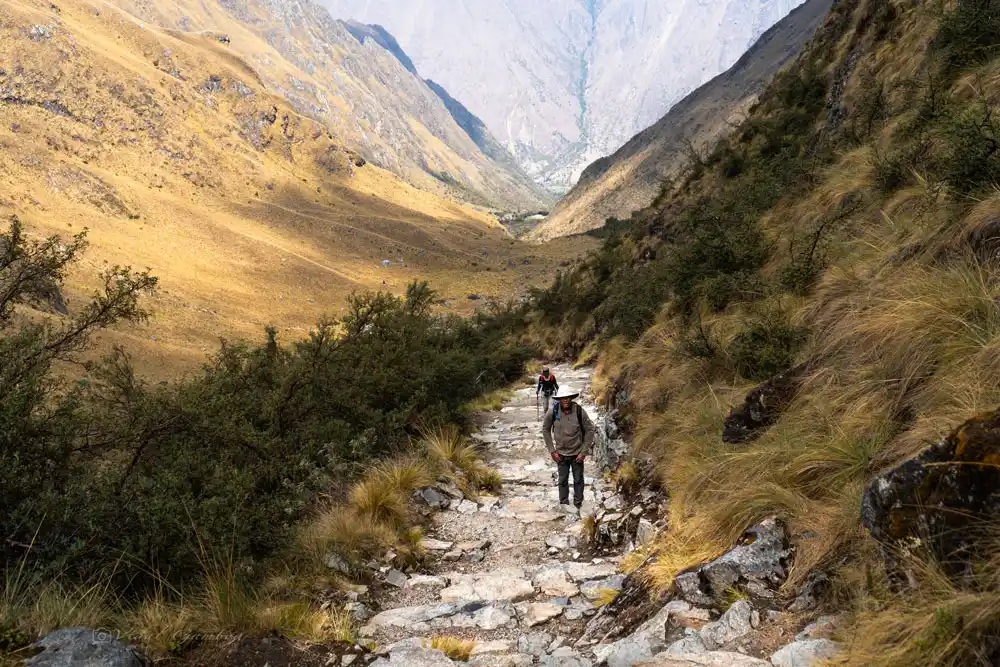
This is the hardest day, be mentally prepared. The morning begins with a steep, sustained climb toward the most famous point on the entire trail: Warmiwañusca, or Dead Woman’s Pass, at 4,215 m (13,828 ft). The name comes from the shape of the mountain ridge when viewed from below, which resembles the silhouette of a reclining woman.
The climb is relentless, involving hundreds of original Inca stone steps. At altitude, even fit hikers slow to a crawl. But the views from the top — on a clear day — are absolutely breathtaking: a panorama of snow-capped Andean peaks stretching in every direction.
After the summit, you descend sharply to Pacaymayo camp, crossing a second (lower) pass along the way.
Distance: 12 km (7.5 miles)
Hiking time: 7–9 hours
Difficulty: Hard — highest elevation gain of the trek
Altitude: 3,000 m → 4,215 m → 3,600 m
Highlight: Dead Woman’s Pass summit, the hardest and most rewarding point
Night: Camp at Pacaymayo (3,600 m)
Pro Tip from our guides: Start Day 2 slowly. Do not try to race up Dead Woman’s Pass. A slow, steady pace beats stopping every 10 minutes to catch your breath. Drink water constantly.
Hiking to Machu Picchu
Day 3: Pacaymayo to Wiñay Wayna (The Archaeological Day)
Most trekkers agree that Day 3 is the most beautiful day on the trail. The morning starts with a climb to a second high pass, Runkurakay, then past the impressive circular ruins of Runkurakay itself. From there, you descend into cloud forest, a dramatic shift in scenery from the high Andean puna of the previous day.
You’ll pass through the ruins of Sayacmarca (Town in the Clouds), perched on a narrow ridge with near-vertical drops on both sides, and Phuyupatamarca (Town Above the Clouds), with its remarkable series of ceremonial baths still carrying water today. The final stretch drops through dense cloud forest to Wiñay Wayna, the last major ruin before Machu Picchu and arguably the most impressive on the entire route.
Distance: 16 km (10 miles)
Hiking time: 8–9 hours
Difficulty: Moderate — more ruins and descents than ascents
Night: Camp at Wiñay Wayna (2,650 m) — the last camp
Wiñay Wayna means ‘Forever Young’ in Quechua named after the pink orchid that grows abundantly along this section of the trail. It is the most spectacular ruin on the entire route after Machu Picchu itself.
Machu Picchu Trek 4 days
Day 4: Sun Gate & Machu Picchu (The Arrival)
The final day begins at 4:00 AM. You wake before sunrise, pack your tent, and join the queue at the trail checkpoint, the gate opens at exactly 5:30 AM. This early start is essential to reach the Sun Gate for sunrise.
The hike from Wiñay Wayna to Inti Punku (the Sun Gate) takes about 1 – 1.5 hours of moderate climbing through the cloud forest. Then, as you pass through the Sun Gate, Machu Picchu appears below you, the entire citadel bathed in early morning light, with mist rising from the valley below. It is one of the most extraordinary sights in the world.
After taking it all in at the Sun Gate, you descend to the citadel itself for a 2-hour guided tour of the ruins. The afternoon is yours to explore further, visit Huayna Picchu or Machu Picchu Mountain if you have a ticket, or simply sit and absorb where you are. In the late afternoon, you descend by bus to Aguas Calientes and take the train back to Cusco.
Distance: 8 km (5 miles) hiking
Hiking time: 1.5 hours to the Sun Gate + 45 minutes to the citadel
Difficulty: Easy — mostly downhill
Altitude: 2,650 m → 2,720 m (Sun Gate) → 2,430 m (Machu Picchu)
Highlights: Sun Gate sunrise, full guided tour of Machu Picchu
Return: Bus to Aguas Calientes → Train to Ollantaytambo → Transfer to Cusco
Hiking to Machu Picchu through the best trek Inca Trail
How Difficult Is the Inca Trail? An Honest Assessment
The Inca Trail is rated moderate to challenging, and the main challenge is altitude, not raw fitness. Here is an honest breakdown:
The Good News
You don’t need to be an athlete. Many first-time trekkers complete it successfully.
Porters carry your heavy gear, you only carry a daypack (5–7 kg max).
The pace is slow and guided, your guide sets a manageable rhythm.
You have 4 days, so there’s time to acclimatize as you go.
The Real Challenges
Altitude: You spend most of the trek above 3,000 m. Dead Woman’s Pass at 4,215 m is where many people struggle.
Inca stairs: Hundreds of original stone steps, especially on Day 2 and 3 — hard on the knees going down.
Length: 44 km in 4 days, with long hiking days (6–9 hours on Days 2 and 3).
Cold nights: Temperatures at camp can drop below 0°C (32°F) at higher elevations.
Who Is It Suitable For?
The Inca Trail is suitable for anyone in reasonable physical shape who acclimatizes properly in Cusco first. You do not need prior trekking experience. We recommend spending at least 2–3 days in Cusco (3,400 m) before the trek to allow your body to adjust to the altitude.
Inca Trail Permits: Everything You Need to Know
This is the most critical part of planning your Inca Trail trip. Permits are strictly limited by the Peruvian government and sell out very fast.
How Many Permits Are Available?
The government limits the Inca Trail to 500 people per day total, this includes trekkers, guides, porters, and agency staff. In practice, this means only around 200 actual trekker spots are available per day. For peak months like May, June, and July, permits often sell out within hours of being released.
When Are Permits Released?
Permits for the following year are typically released in October. So permits for 2026 treks became available in October 2025. If you’re planning to trek in the peak dry season (May–September 2026), you should have booked several months ago, but spots may still be available for shoulder months like April, October, or November.
How Do I Get a Permit?
You cannot buy Inca Trail permits independently. Permits must be purchased through a licensed, authorized tour operator, like Machu Picchu by Locals. When you book your tour, we handle the entire permit procurement process for you. We submit your full legal name and passport number to the government system, and your permit is non-transferable.
What Happens if Permits Are Sold Out?
If the Inca Trail permits are fully booked for your dates, don’t panic, there are excellent alternatives that also reach Machu Picchu:
Salkantay Trek (5 or 4 days); arguably more dramatic scenery than the Inca Trail
The dry season is the best time to hike the Inca Trail. Skies are clearer, trails are drier, and mountain views are more spectacular. June, July, and August are the most popular months, and consequently the first to sell out on permits. May and September are often considered the ‘sweet spot’: good weather with slightly fewer crowds.
Best weather: June, July, August
Best balance of weather + availability: May, September
Temperatures (daytime): 15–20°C (59–68°F)
Temperatures (night at camp): 0–5°C (32–41°F) — bring warm layers
Wet / Shoulder Season: October – January (Still Good)
The shoulder season brings more rain, usually afternoon showers rather than all-day downpours, but also lush green landscapes, fewer crowds, and sometimes lower prices. Morning hikes are often clear. If you don’t mind occasional rain and want more trail to yourself, October and November are great options.
October–November: Transition, mostly dry mornings, possible afternoon showers
December–January: Wetter but still manageable. Lush green scenery.
Rainy Season: February – April
February is completely off-limits, the trail is closed for the entire month for annual maintenance and environmental recovery. March and April are the wettest months, with muddy trails and lower visibility, though April starts drying out and can be beautiful with flowers in bloom.
❌ Never plan an Inca Trail trek in February, the trail is 100% closed. No exceptions.
MONTH
CONDITIONS
January
Rainy season — trail open but wet
February
TRAIL CLOSED — annual maintenance
March
Rainy season — muddy trails
April
Improving — flowers bloom, fewer crowds
May
Excellent — dry season begins, great availability
June
Peak — best weather, sells out fast
July
Peak — best weather, sells out fast
August
Peak — best weather, sells out fast
September
Excellent — dry season, slightly quieter
October
Good — shoulder season begins
November
Good — occasional showers, fewer crowds
December
Wetter but festive — Inti Raymi period
Inca Trail Cost: What Does It Actually Include?
The Inca Trail is not cheap, and that’s intentional. Strict regulations, limited permits, mandatory guides, and porter welfare standards all contribute to the cost. Here’s what your money covers:
What’s Typically Included in an All-Inclusive Inca Trail Tour
Government-issued Inca Trail permit (linked to your passport)
Machu Picchu entrance ticket
All meals on the trail: breakfast, lunch, afternoon snacks, dinner (Days 1–3), breakfast (Day 4)
Return train from Aguas Calientes to Ollantaytambo
Return bus from Aguas Calientes to Machu Picchu gate
Private transfer Cusco – KM 82 trailhead
What Is NOT Usually Included
Sleeping bag (rent from us or bring your own)
Trekking poles (recommended, rentable in Cusco)
Porter to carry your personal bag ($50–80 USD extra)
Tips for guides, porters, and cook (strongly encouraged)
Travel insurance (required, must cover high-altitude trekking)
Optional extra hikes: Huayna Picchu or Machu Picchu Mountain tickets
Our Classic 4-Day Inca Trail starts from $750 USD all-inclusive. See full pricing and inclusions →
Inca Trail Packing List: What to Bring
Your porter carries your main duffel bag (maximum 7 kg / 15 lbs of your personal gear). You carry a daypack with just your essentials during each hiking day. Here’s what you need:
Clothing
Moisture-wicking base layers (top and bottom), 2 sets
Fleece mid-layer or down jacket for cold evenings and mornings
Waterproof rain jacket, essential even in dry season
Waterproof rain pants
Trekking pants or convertible zip-off pants, 2 pairs
Warm hat and gloves for Dead Woman’s Pass and cold nights
Cash in soles: tips for guides/porters ($20–30 USD per staff member), bathroom fees
Camera or fully charged phone with extra batteries/power bank
Weight tip: Your porter carries your duffel bag (max 7 kg). Keep your daypack light, ideally under 6 kg, including water, snacks, rain gear, camera, and a warm layer. Do NOT bring heavy camera equipment.
Altitude on the Inca Trail — How to Prepare
Altitude sickness (soroche) is the #1 challenge on the Inca Trail. Here’s what you need to know:
The Altitude Numbers
Cusco (where you acclimatize): 3,400 m (11,150 ft)
KM 82 trailhead (Day 1 start): 2,750 m (9,022 ft)
Wayllabamba camp (Night 1): 3,000 m (9,843 ft)
Dead Woman’s Pass (Day 2 summit): 4,215 m (13,828 ft) ← hardest point
Wiñay Wayna (Night 3): 2,650 m (8,694 ft)
Machu Picchu (finish): 2,430 m (7,972 ft)
How to Acclimatize
Arrive in Cusco 2–3 days BEFORE your trek starts
Take it easy on Day 1 in Cusco, rest, avoid alcohol, stay hydrated
On Day 2, do a short, easy hike (like the Sacred Valley) to begin altitude adaptation
Drink coca leaf tea, a traditional Andean remedy widely available in Cusco
Stay well hydrated throughout (3–4 liters of water per day on the trail)
Ask your doctor about Diamox (acetazolamide), a prescription medication that helps prevent altitude sickness
Symptoms to Watch For
Mild: Headache, fatigue, shortness of breath, loss of appetite, common and manageable
Severe: Confusion, loss of balance, inability to walk, requires immediate descent and medical attention
Our guides carry oxygen on every trek. If you experience moderate to severe symptoms, tell your guide immediately. No summit is worth your health.
How to Book the Inca Trail with Machu Picchu by Locals
Booking with a local, licensed operator is the only way to trek the Inca Trail. Here’s how our process works:
Step 1: Choose Your Route and Dates
Decide which Inca Trail option suits you, Classic 4-Day, Short 2-Day, Private, or 1-Day. Then choose your start date. Remember: peak season dates (May–August) sell out 6–8 months in advance.
Step 2: Send Your Booking Inquiry
Contact us via our website or WhatsApp (+51 951 359 694) with your preferred dates, number of people, and passport details. We’ll check permit availability immediately.
Step 3: Confirm with a Deposit
Once we confirm permit availability, secure your spot with a deposit. We submit your passport details to the government permit system, this process is immediate and your spot is confirmed once the permit is issued.
Step 4: Receive Your Pre-Trek Briefing
The evening before your trek, we host a group pre-trek briefing in Cusco where you meet your guide, review the itinerary, get last-minute packing tips, and confirm your 5:00 AM pickup time.
Step 5: Trek the Inca Trail!
Your adventure begins. Our guides, porters, and cook team take care of everything so you can focus on the experience of a lifetime.
READY TO BOOK YOUR INCA TRAIL ADVENTURE?
Machu Picchu by Locals is a locally-owned operator based in Cusco, Peru. Small groups, licensed local guides, all-inclusive pricing, and genuine expertise on every trail.
You don’t need to be an athlete, but you should be in reasonable shape. The main challenge is altitude, not raw fitness. Regular walkers who spend 2–3 days acclimatizing in Cusco and take Day 2 slowly can complete the classic route. We recommend doing some light cardio training in the weeks before your trip.
Can I hike the Inca Trail independently without a guide?
No. Independent trekking on the Inca Trail is strictly forbidden by the Peruvian government. Every trekker must be part of a licensed tour operator group. This regulation exists to protect the trail, manage permits, and ensure trekker safety.
How far in advance do I need to book?
For peak season (May–August), book 6–8 months in advance. Permits for these months sell out extremely fast, often within hours of being released in October. For shoulder months (April, October, November), 2–4 months in advance is usually sufficient, though earlier is always safer.
What happens if it rains on my trek?
Rain on the Inca Trail is always possible, even in dry season. Our guides are experienced in all conditions, and your camping equipment is fully weatherproofed. A good rain jacket and rain pants will keep you comfortable. The cloud forest on Day 3 is actually most beautiful after rain, misty and atmospheric.
Is the Inca Trail child-friendly?
The Classic 4-Day trail is not recommended for young children due to the altitude and long hiking days. However, the Short 2-Day trail is manageable for older children (10+) who are active. For families with younger children, the Machu Picchu day tour from Cusco by train is a better option.
Can I upgrade to a private porter for my personal bag?
Yes! Most operators (including us) offer the option to hire a personal porter to carry your daypack during the hike, for an additional fee of around $50–80 USD. This is a popular upgrade especially for Day 2 and is worth considering if you have any physical limitations.
What is the bathroom situation on the trail?
There are basic toilet facilities (pit latrines) at each campsite and at designated rest stops along the trail. They are rustic but functional. There is a small fee (1–2 soles) at some public facilities. Bring toilet paper and hand sanitizer in your daypack.
What’s the difference between Inca Trail and Salkantay Trek?
The Inca Trail is more historical, it passes multiple Inca ruins and is the only route that enters Machu Picchu through the original Sun Gate. The Salkantay Trek is more dramatic in terms of mountain scenery, it passes close to the 6,271m Salkantay peak. The Salkantay does not require government permits and is available year-round (except February). Both are outstanding experiences.
Compare them here: Salkantay Trek 5 Days
Related Posts You’ll Find Useful
Inca Trail 4 Days vs 2 Days — Which Is Right for You?
Salkantay Trek vs Inca Trail — The Honest Comparison
How to Spend 3 Days in Cusco Before Your Trek
Altitude Sickness in Cusco — Complete Prevention Guide
Machu Picchu Entrance Tickets — Everything You Need to Know in 2026
What to Do in Aguas Calientes — The Ultimate Guide
Written by the local experts at Machu Picchu by Locals; a Cusco-based tour operator specializing in trekking and adventure tours to Machu Picchu since 2018. All information updated for 2026.
Would you like to explore the Peruvian Andes? Stunning
landscapes, snowy peaks, beautiful lakes, and small Andean
communities high in the mountains—Ausangate Trek is for you.
Would you like to explore the Peruvian Andes? Stunning
landscapes, snowy peaks, beautiful lakes, and small Andean
communities high in the mountains—Ausangate Trek is for you.
Would you like to explore the Peruvian Andes? Stunning
landscapes, snowy peaks, beautiful lakes, and small Andean
communities high in the mountains—Ausangate Trek is for you.
Would you like to explore the Peruvian Andes? Stunning
landscapes, snowy peaks, beautiful lakes, and small Andean
communities high in the mountains—Ausangate Trek is for you.
Our travellers are our best advocates, and they frequently recommend our specialist travel services to friends, colleagues and family when planning a trip to our region.
                  Connie C      Rainbow mountain with Jhon
What a great experience during our day hike to Rainbow mountain, we were only 7 people in the group and our guide was very peofessional leading us up to the mountain, very informative and funny. We reached the Rainbow mountain early before the rest of the groups and have best view. We also hike towards Red Valley, which is an incredible spot to explore and walk around. Our driver Miguel was really nice person and helpful. Food and the whole organization were 5/5. We definitely recommend them!              Willian L      Rainbow Mountain Trek
The Rainbow Mountain Tour was incredible. I just got back from the day trek, and MbL organised everything very well. Pickup was on time, as was transportation and meals (breakfast and lunch included; your guide was great too). We were early at the view point to avoid the crowds, which normally occur during this tour. Jimmy, the guide, was always attentive and had many things to tell us while we were hiking up. The price is worth it!              Lucena W      Inca Jungle Trail 4-Day
We had such a nice time hiking to Machu Picchu through the Inca Jungle for four days with our guide Ronald. We were a group of 10 people, and Ronald did a great job during the time we were on the tour. The actvities; biking, rafting and zipline were fun with all the safety gears, even our guide Ronald came with us to make sure we were super safe. Hiking into the forest while we visit some local families and their farms, makes different experience and allows us to discover the real life of the area, local products, animals and many histories, which is one of the highlights of this Inca Jungle trip. Definitely, this is the most adventurous way to reach Machu Picchu.
Need help? Speak with us
Start a conversation
Hello! Click on one of our members below to chat on Whatsapp